
Samudra Manthan: The Mythology Behind Kumbh Mela Explained
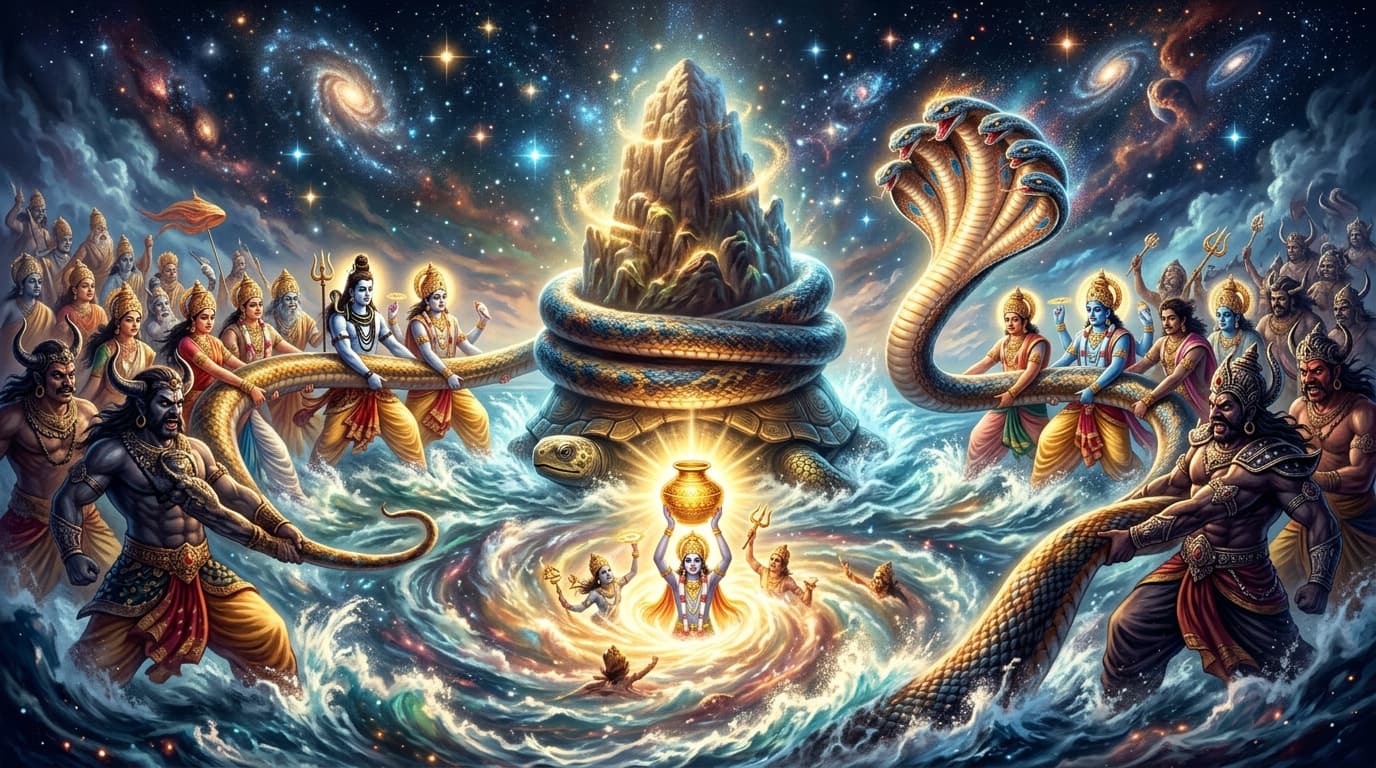
The Samudra Manthan (Churning of the Ocean of Milk) is the mythological event that gave birth to the Kumbh Mela. According to the Bhagavata Purana and Vishnu Purana, the Devas and Asuras churned the cosmic ocean to extract the Amrit (nectar of immortality). During a 12-day celestial battle over the Amrit Kalash, four drops of nectar spilled on Earth at Prayagraj, Haridwar, Ujjain, and Nashik — creating the four sacred Kumbh Mela cities.
Every pilgrim who dips in the Godavari at Ramkund during the Simhastha Kumbh Mela is symbolically bathing in the divine nectar that fell from heaven. But what exactly happened in this cosmic event? Here is the complete story.
The Curse of Sage Durvasa
The story begins with Sage Durvasa, a notoriously short-tempered sage known for his powerful curses. One day, Durvasa offered a divine garland to Lord Indra (the king of the Devas). Indra, intoxicated by pride, carelessly placed the garland on his elephant Airavata, who trampled it.
Enraged, Durvasa cursed all the Devas to lose their divine powers and immortality. Weakened and terrified, the Devas turned to Lord Vishnu for help.
Vishnu's Grand Plan: Churn the Ocean
Lord Vishnu devised a plan: churn the Kshirsagar (Ocean of Milk) to extract the Amrit — the nectar that would restore the Devas' immortality. But the task was so monumental that the Devas could not do it alone. Vishnu instructed them to form a temporary alliance with their enemies, the Asuras, promising them a share of the nectar.
The Churning Setup
- Churning Rod: Mount Mandara — an enormous cosmic mountain — was used as the churning rod.
- Churning Rope: Vasuki, the king of serpents, was wrapped around the mountain as the rope.
- The Base: Lord Vishnu himself took the form of Kurma (a giant tortoise) and placed himself under Mount Mandara to prevent it from sinking into the ocean floor.
- The Teams: The Devas held Vasuki's tail, and the Asuras held the head. They pulled alternately, spinning the mountain and churning the ocean.
The 14 Treasures That Emerged
As the ocean churned, 14 extraordinary treasures (Ratnas) emerged, including:
- Halahala: A deadly poison so powerful it could destroy all creation. Lord Shiva drank it to save the universe, turning his throat blue (hence the name Neelkanth).
- Kamadhenu: The divine wish-fulfilling cow.
- Airavata: The white divine elephant.
- Kalpavriksha: The wish-fulfilling tree.
- Goddess Lakshmi: The goddess of wealth, who emerged and chose Lord Vishnu as her consort.
- And finally — the Amrit Kalash: The golden pot of nectar, carried by Dhanvantari (the divine physician).
The Battle for the Nectar
The moment the Amrit Kalash appeared, the Asuras snatched it and refused to share. A fierce battle broke out between the Devas and Asuras. Lord Vishnu then took the form of Mohini, a mesmerizingly beautiful enchantress, and tricked the Asuras into handing over the pot.
As Mohini distributed the Amrit exclusively to the Devas, the demon Rahu disguised himself as a Deva and drank some nectar. The Sun and Moon gods spotted the deception and alerted Vishnu, who beheaded Rahu with his Sudarshana Chakra. But because Rahu had already swallowed the nectar, his head became immortal — and to this day, Rahu and Ketu (the head and body) chase the Sun and Moon, causing eclipses.
The Four Drops: Birth of the Kumbh Mela
During the 12-day battle (12 days of the gods = 12 human years), Vishnu's vehicle Garuda carried the Amrit Kalash across the sky. During this flight, four drops of Amrit spilled from the pot and fell to Earth at these four locations:
- Prayagraj (Allahabad): At the Sangam (confluence of Ganga, Yamuna, and Saraswati).
- Haridwar: On the banks of the Ganga.
- Ujjain: On the banks of the Shipra river.
- Nashik: At Ramkund on the Godavari River.
These four spots are believed to become supercharged with divine energy when specific planetary alignments recur — which is why the Kumbh Mela is held at each location on a rotating 12-year cycle.
Why This Matters for Your Pilgrimage
When you bathe at Ramkund during the Shahi Snan, you are not just taking a dip — you are symbolically immersing yourself in the same divine nectar that grants immortality. This is why millions of pilgrims travel thousands of kilometers, endure massive crowds, and wait for hours — for a single sacred dip that is believed to wash away the sins of a thousand lifetimes.
Plan your pilgrimage with our Premium Ebook which includes the complete spiritual itinerary, mantras to chant during the bath, and the most auspicious timings for each Shahi Snan.
Frequently Asked Questions
What is Samudra Manthan?
Samudra Manthan (Churning of the Ocean of Milk) is a Hindu mythological event where the Devas and Asuras churned the cosmic ocean to extract the Amrit (nectar of immortality). This event is described in the Bhagavata Purana and Vishnu Purana.
How is Samudra Manthan connected to Kumbh Mela?
During the battle for the Amrit Kalash, four drops of the divine nectar fell on Earth at Prayagraj, Haridwar, Ujjain, and Nashik. The Kumbh Mela is held at these four sites to commemorate the event.
Why did Shiva drink poison during Samudra Manthan?
The deadly Halahala poison emerged from the ocean and threatened to destroy all creation. Lord Shiva drank the entire poison to save the universe, and Goddess Parvati held his throat to prevent it from spreading, turning his throat blue — earning him the name Neelkanth.
Related Articles


Planning Your Trip?
Don't leave anything to chance. Download our massive 63-page Premium Ebook covering every aspect of the 2027 Nashik Kumbh Mela.
Get The Master Guidearrow_forward